


Ghost crabs are typical inhabitants of high zones on sandy beaches. Continue Reading
Archive | February, 2013

Calcinus exploratory
Posted on 17 February 2013 by Nazca admin
Hermit crabs live in empty shells of different marine molluscs in order to protect their soft abdomen. Continue Reading

Pollicipes elegans
Posted on 17 February 2013 by Nazca admin
Barnacles adhere themselves to rocks in the intertidal zone. They successfully settle on exposed areas subject to violent wave action and high desiccation stress. Continue Reading

Brissus obesus
Posted on 17 February 2013 by Nazca admin
This sea urchin is found buried under soft bottom sediments, where is feeds on small particles of detritus. Continue Reading

Toxopneustes roseus
Posted on 17 February 2013 by Nazca admin
The body of this sea urchin is covered by pedicles (toxin-filled spines) that resemble small pink flowers. Continue Reading

Heliaster cumingii
Posted on 17 February 2013 by Nazca admin
This sea star is a predator in rocky intertidal zones, where its main prey are barnacles.

Nidorellia armata
Posted on 17 February 2013 by Nazca admin
This sea star is easily recognizable by its large black dorsal spines radially distributed Continue Reading

Aplysilla sulphurea
Posted on 15 February 2013 by Nazca admin
Sponges feed on planktonic organisms using small flagellated cells to create interior currents within their body walls Continue Reading

Unidentified Sponge
Posted on 15 February 2013 by Nazca admin
Sponges are simple sessile animals that lack internal organs, nerves, and muscles. Continue Reading

Bivalve Spondylus
Posted on 06 February 2013 by Nazca admin
Why investigate Spondylus?
We are currently investigating the ecology and population dynamics of the bivalve genus Spondylus, also known as “spiny oysters”. The shells are famous for their beauty among collectors worldwide. Visitors of Ecuador have surely seen the amazing shells, either found clean and polished entirely or the beautiful jewellery that is made out of it, both found widely distributed in shops and on local markets. Very few visitors are probably aware that these slow-growing animals faced a heavy fishery pressure during the last decade and are nowadays a more and more disappearing resource. The fishery on Spondylus is still not regulated and consequently stocks appear to be severely overexploited. A detailed study of the ecology and population dynamics of Spondylus species is therefore urgently required to provide the information necessary for a sustainable management and thus protection of this ecologically and economically valuable resource.
History

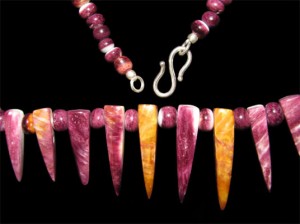


Belonging to the class of Bivalvia, the family Spondylidae (Gray, 1826) consists of only one genus: Spondylus (Linnaeus, 1758) with current estimates of different living species between 70 and 80, many of them under scientific revision. This family is closely related to the family Pectinidae (Scallops) with whom they share the complex eyes around the mantle and a relatively well developed nervous system. Spondylus is usually cemented to the substrate instead of using a byssus. Despite their abundance in the tropical oceans of the world, very little is known about basic biology and ecology of Spondylidae.
Three species are found along the coast of Ecuador, Spondylus calcifer, S. princeps and S. leucacanthus. Their large and magnificent shells have a long history in South American culture as ceremonial offerings and currency. A lively community of anthropologists is exploring and discussing the importance that Spondylus featured in South America during Valdivian and Incan times. Nowadays, Spondylus is again of significant commercial value in Ecuador regarding handicraft (jewellery) and alimentation.
Further investigations
We are also investigating the suitability of Spondylus shells as archives of long-term environmental variability. As in many bivalves, Spondylus shells display growth rings that are formed due to changes in environmental parameters such as water temperature, salinity, depth and light which influence the availability of food and therefore the metabolism and the growth of the animal. Owing to the presumed longevity of Spondylus, their shells may serve as archives of long-term environmental variability, i.e. its morphological and biogeochemical properties may reflect the influence of large-scale climate phenomena like ENSO (El Niño Southern Oscillation). The eastern tropical pacific is a key climate sector and calcifying marine organisms such as bivalves can provide high-resolution records of environmental parameters.

More Information:
Alfred Wegener Institute for Polar and Marine Research


Photos from our Flickr stream
See all photos


-
CATEGORIES
- Ascidiacea (ascidians) (3)
- Bivalve Spondylus (9)
- Cnidaria (medusae and polyps) (10)
- Conservation Areas (2)
- Crustacea (crustaceans) (7)
- Echinodermata (echinoderms) (4)
- GAP Analysis (2)
- Marine mammals (3)
- Marine Mapping (2)
- Marine Protected Areas (3)
- Marine Species Ecology (2)
- Mollusca (molluscs) (17)
- News (7)
- Polychaeta (bristle worms) (2)
- Porifera (sponges) (2)
-
ARCHIVES
- September 2018 (1)
- September 2014 (1)
- February 2013 (68)
- September 2011 (1)
- August 2011 (2)
- July 2011 (2)
